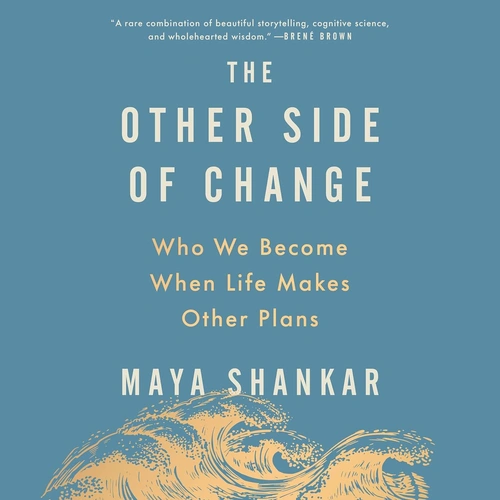
I was at a small dinner party last month. Everyone around the table was in their early thirties. By the second glass of wine, the conversation turned quiet. One friend had just been laid off from a job she loved. Another was ending a seven-year relationship. They both said the same thing: “I don’t know who I am anymore.” That question haunted me. So I picked up Maya Shankar’s new book, The Other Side of Change: Who We Become When Life Makes Other Plans. And I found something I didn’t expect. Not a self-help manual, but a mirror. The question at its heart is simple and brutal: When the script of your life gets torn up, what is left of you?
Shankar opens with her own story. She was a child prodigy violinist. Playing Carnegie Hall. On track for a major career. Then a sudden hand injury ended everything. She had to rebuild from scratch. Later, as a cognitive scientist and White House advisor, she studied how other people do the same. She calls this process “identity renegotiation.” It is not pretty. In one chapter, she describes a woman named Priya who was a top corporate lawyer. Priya defined herself by her briefs, her billable hours, her corner office. When she was pushed out of her firm, she spent months in a fog. She could not tell her friends she was “unemployed.” The word felt like a failure of her entire person. That is the trap, Shankar argues. We fuse our identity too tightly to a single role. That role becomes a cage. And when the cage breaks, we think we have nothing left. But Shankar does not just diagnose the problem. She offers a path, albeit a messy one. She shows how Priya slowly learned to separate her worth from her job title. How she found value in being a mentor, a friend, a gardener. The book does not reveal Priya’s final destination. And that is the point. The journey matters more than the arrival. So here is the layer beneath: What if the crisis is not the enemy? What if it is the only door?
The core theme of The Other Side of Change is that stories we tell ourselves can either save us or trap us. Shankar uses a powerful image throughout the book: a kaleidoscope. When you turn the tube, the pieces of colored glass fall into a new pattern. They are the same pieces. But the picture changes. She applies this to identity. When a major change hits, we do not need to find a brand new set of pieces. We need to turn the tube. We need to see the old pieces in a new configuration. One of the most striking examples comes from a chapter on long-term relationships. She profiles a man named Tom, who was devastated after his wife of twenty years left him. He kept saying, “I am a husband.” That was his entire story. Shankar did not tell him to stop grieving. She asked him: “What other stories have you been living, quietly, all this time?” He mentioned his love for woodworking. His late-night conversations with his brother. His habit of making elaborate breakfasts on Sundays. Those were all pieces of glass. They just had not been arranged in the center of the kaleidoscope yet. The imagery here is not decorative. It is operational. Shankar shows that change is not subtraction. It is reorganization. She also admits the limits of her metaphor. Some changes are brutal. The reorganization takes years. But the kaleidoscope frame gives the reader a handle. It is a tool, not a cure. And that honesty makes the book trustworthy. She does not promise you will find a prettier pattern. She promises you can find a pattern at all.
I will be honest. I finished the book and felt a strange relief. Not a solution. A permission slip. The permission to stop pretending that my life is a linear climb. Shankar writes about what she calls “the post-change self.” This is the person you become after the disaster, after the layoff, after the breakup. She argues that this self is not a diminished version of the old one. It is a version that has been forced to expand. She leans on research from psychology about “post-traumatic growth.” But she refuses to romanticize it. Growth does not mean the pain was worth it. It means the pain happened, and you now hold more complexity. That is the core insight. And it resonates across eras. Think of the current wave of layoffs in tech. The quiet quitting. The collapse of the “hustle culture” myth. Every generation has its own version of this crisis. For people in their thirties now, the crisis is about the end of certainty. We were told to follow our passion. To build a career. To find “the one.” Shankar does not mock these dreams. She respects them. Then she gently asks: What happens when the dream does not survive reality? Her answer is not a slogan. It is a practice. It is the slow, unglamorous work of noticing all the other pieces in the kaleidoscope. I think about my friend at that dinner party. The one who lost her job. She has started painting again. Something she abandoned in college. She says it feels strange and small. But it is a piece of glass. Maybe that is what The Other Side of Change offers us. Not a new map. But a new way of holding the pieces we already have.
