You know that feeling, don’t you? Your brain is like a TV you can’t turn off. It plays your past regrets, your future worries, what other people think of you—and you just can’t find the remote. Don’t panic. You’re not alone.
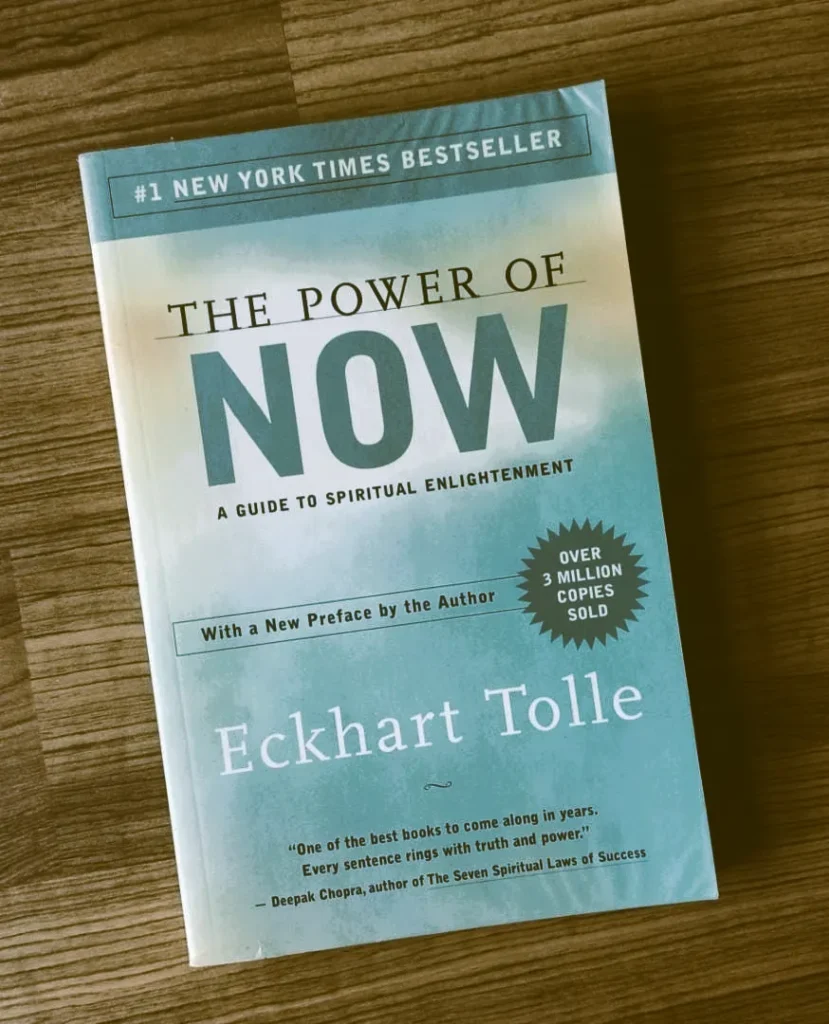
The biggest thing I took away from The Power of Now is this: most of the pain we carry around every day comes from one source—the noise inside our own heads. Eckhart Tolle doesn’t mess around. He doesn’t give you complicated arguments or try to cheer you up. He just puts it right in front of you. You suffer because you’re always living somewhere else. The past. The future. Anywhere but here.
He tells a story from his own life. Crippling anxiety. Depression so deep he wanted to end it. Then one early morning, the voice in his head—the one that never stops complaining, analyzing, worrying—just froze. He asked himself one question: Who is the “me” that’s watching this voice? That question changed the way he saw his mind.
See? There’s no fictional hero in this book. The only characters are you and your own mind. Tolle makes you slowly realize: what’s really trapping you isn’t life itself. It’s the story you keep telling yourself. I don’t want to spoil too much. But that moment—when you suddenly feel that you are not your own thoughts—it’s better than finally falling asleep after lying awake all night.
Push a little deeper, and this book is really teaching you an inner skill. It doesn’t want you to memorize a bunch of ideas. It wants you to actually run an experiment—when you’re stuck in traffic, when your boss lays into you, when you’re tossing and turning at 2 a.m. Try putting your hand on your chest. Feel your breath. Then move your attention from “how dare they do this to me” to “what I actually feel in my body right now.” Just try it.
In that moment, you touch something solid. Something clear. A presence without judgment. The first time I read that part, I felt like a stone settled at the bottom of a river — still, untouched by the waves above. The waves were still there, but they no longer controlled me. Tolle doesn’t ask you to believe in any religion. No meditation poses, no chanting. He only asks you to do one thing: be honest about what you feel — in this moment, in this exact place. Even if it’s “I’m not good enough”—don’t push it away. Just sit quietly and watch it. Slowly, you start to see that pain isn’t your enemy. You don’t have to defeat it. You just have to stop. Stop feeding the cycle.
So here’s the real truth. The most precious thing about this book isn’t how brilliant Tolle is. It’s that he challenges you to find your own answer. You don’t have to be perfect by the last page. You can be anxious and still try to feel your breath. You can be angry and still notice that you’re angry. The book won’t scold you. Won’t rush you. It just quietly tells you one small thing you can do, right now.
Maybe it’s drinking a glass of water. Maybe it’s one deep breath. Maybe it’s just stopping and staring at the ceiling for five minutes. Next time you feel like you’re drowning in your own thoughts—just flip open two pages. Even if you only remember one sentence: Now is the only thing you truly have. You’ll find that one sentence can last you a very long time. Sometimes the simplest ideas stay with you the longest.