I was three days into a family holiday, and dinner had just dissolved into another argument about taxes. My uncle was red-faced, I was smug, and nobody was listening. Later, alone on the balcony, I remember thinking: we’re both intelligent people. Why can’t we even agree on what is fair?
That night I started The Righteous Mind, and within an hour I understood something uncomfortable. My uncle and I were not failing at rational discussion. We were never having one. The question that haunted me through every chapter is this: if our moral judgments are formed in a split second by intuition, and reason only arrives afterwards to justify them, then what is the actual point of trying to persuade anyone of anything?
The Elephant and the Rider
Jonathan Haidt opens with a deceptively simple image. The mind is an elephant, and reason is the rider perched on top. The rider thinks he is in charge. He picks the direction, he holds the reins, he believes he is the one making decisions. In reality, the elephant goes where it wants to go, and the rider’s main job is to look useful while finding post-hoc explanations for the journey. The elephant is our gut—the instant flash of like or dislike, right or wrong, that fires before conscious thought. The rider is the clever lawyer who constructs arguments after the verdict is already in.
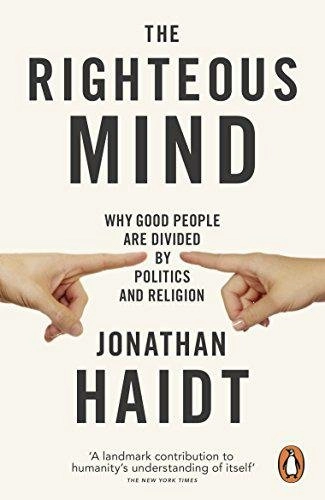
I felt personally attacked, honestly. I had spent years believing my political positions were the result of careful analysis. Haidt’s research suggests I had it backwards. I held those positions because they felt right, and my reasoning was just the press release. He walks through study after study, including his own, showing that people who are asked to justify their moral judgments become more entrenched, not more open. When you ask someone why they believe something, they rarely reconsider. They double down, because the rider is now committed to defending the elephant’s choice.
His second major point is the one that made me put the book down and stare at the wall. Morality is not just about harm and fairness, which is what modern liberals tend to focus on. There are six foundations, he argues: care, fairness, liberty, loyalty, authority, and sanctity. And here is the kicker: conservatives, in his data, tend to use all six. Liberals tend to rely on three. This is not a claim that one side is right. It is a claim that one side is working with a narrower moral vocabulary, and that this narrowness explains a great deal of our mutual incomprehension.
Why We Can’t Hear Each Other
The most painful chapter for me was the one about the moral foundations questionnaire. Haidt and his colleagues asked over two thousand Americans to fill out the survey as they thought a typical liberal or conservative would. The results were stark. Moderates and conservatives could accurately predict liberal responses. Liberals, especially very liberal ones, were terrible at predicting conservative responses. They assumed conservatives would oppose caring for animals and valuing justice. They were wrong, and they were wrong in a way that revealed a basic failure of imagination.
This landed hard because I recognized myself. I had built a cartoon version of my uncle’s morality, complete with a soundtrack of my own superiority. I had never asked what values he was actually defending. I had assumed his positions were simply less evolved versions of mine. Haidt’s research suggests that this assumption is itself a moral intuition, one that feels so self-evident we never examine it. We are not just disagreeing about facts. We are disagreeing about what counts as a moral question at all.
He also tackles the evolution of morality in a way that surprised me. We are not purely selfish creatures, he argues, and we are not purely altruistic either. We are groupish. Humans evolved to compete within groups but cooperate across them, and this dual nature is why we can be both generous to our own and cruel to outsiders. This explains why religion, which many secular people dismiss as irrational, has been so persistent. It binds groups together. It creates trust. It makes cooperation possible at scales that would otherwise be unthinkable. The problem is that what binds also blinds. Every moral matrix, left or right, religious or secular, creates its own version of reality, and inside that matrix, everyone else looks dangerously wrong.
The Uneasy Gift of This Book
Let me be honest about the weaknesses. Haidt’s writing is clear but occasionally repetitive. His metaphors, while vivid, sometimes oversimplify. The evolutionary arguments in the third section are interesting but speculative. And his conclusion, that we need both liberal and conservative insights to flourish as a nation, feels a little too neat. It does not tell you what to do when the other side is actively harming people. It does not resolve the tension between understanding your enemy and stopping them.
But the book does something more valuable than providing answers. It gives you a language for your own blindness. I have not become a better debater since reading it. I have not convinced a single person to change their mind. What I have gained is the capacity to pause. When I feel that flash of righteous certainty, I now recognize it for what it is: an intuition, not a truth. I still act on it sometimes. But I no longer mistake it for logic.
The best part of this book is not the science. It is the humility it plants in you. You come away less sure of your own reasoning, which is uncomfortable. You also come away more curious about other people, which is a kind of grace. Haidt quotes the theologian Reinhold Niebuhr: “The final form of sin is the sin of the righteous.” That is the sentence I keep turning over. This book will not make you kinder. But it might, if you sit with it long enough, make you slightly less certain that you are the one who is right. And these days, that feels like a small miracle.
