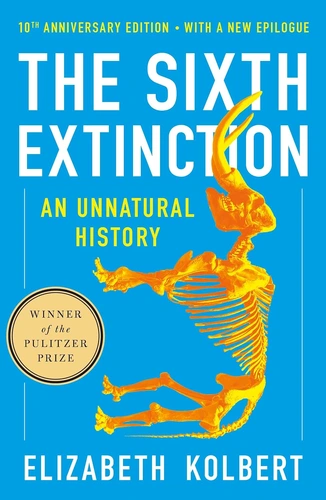
I was at a friend’s backyard barbecue last summer, and her six-year-old asked me why there were no lightning bugs anymore. I said I didn’t know. But later, I found myself thinking about that question. It’s the kind of small, quiet disappearance that doesn’t make the news. A species fades, and we barely register it. That’s the feeling Elizabeth Kolbert captures in The Sixth Extinction: An Unnatural History, a book that won the Pulitzer for nonfiction in 2015. It isn’t a scolding lecture about recycling. It’s something stranger and more intimate. Kolbert travels from a bat cave in New York to a coral reef in Australia, watching scientists document creatures vanishing one by one. She doesn’t yell about guilt. She asks: What does it mean to be the first species in history to understand its own role in a mass extinction, and to keep going anyway?
The character we don’t notice
Kolbert herself is the quiet protagonist here. She’s not a hero. She’s a journalist with a worn notebook and a willingness to get muddy. She follows researchers who measure acidity in the ocean and dig up fossilized ammonites in Italy. I found myself drawn to her voice because she never pretends to have answers. She admits confusion. At one point, she visits the Great Barrier Reef and describes it not as a vibrant paradise but as a graveyard of bleached coral, white as bone. The core conflict isn’t between good and bad people. It’s between us and our own habits. We need energy, so we burn fossil fuels. The planet warms. Species die. Kolbert doesn’t point fingers. She just shows the math. And the suspense is brutal: we know the ending, but we keep reading, hoping for a twist that doesn’t come. This is not a story about saving the world. It’s about watching it change while holding a microscope.
The craft of quiet grief
The book’s core theme is not environmentalism in the usual sense. It’s absence. Kolbert writes about extinction as a slow erasure, and her key imagery is the fossil. She walks through museums and digs through layers of rock, pointing to where life used to be and now isn’t. There’s one moment that stopped me cold. She describes the Panamanian golden frog, a tiny creature that no longer exists in the wild. Scientists tried to save it by keeping the last few in a lab. But the fungus that killed them was everywhere. Kolbert doesn’t say “we should have done more.” She just says they’re gone. The author’s craft here is restraint. She lets the facts do the emotional work. The frog is dead. The coral is white. The bat is extinct. And the reader sits with that silence. What I realized is that Kolbert is showing us a universal pattern: we are the asteroid. Not because we’re evil, but because we’re human. We build, we consume, we forget.
The question that stays
I’ll be honest. I finished this book feeling hollow, not inspired. There is no call to action at the end, no checklist of ten things you can do. Kolbert isn’t selling hope. She’s documenting something real. The book’s limitation is that it can feel overwhelming, even paralyzing. You might put it down and stare at the wall. But that’s not a flaw. It’s the point. What the book offers is a kind of clarity. It names the thing we all sense but avoid: something is leaving, and we are the ones who opened the door. I think about that six-year-old at the barbecue. She will grow up in a world with fewer fireflies, fewer frogs, fewer species. And maybe the best we can do is not to pretend otherwise. Maybe the first step is just to admit we’re in the middle of something huge, and we don’t know how to stop it. That’s the question Kolbert leaves you with. Not “how do we fix it?” But: what does it mean to live well in a world that is ending?
