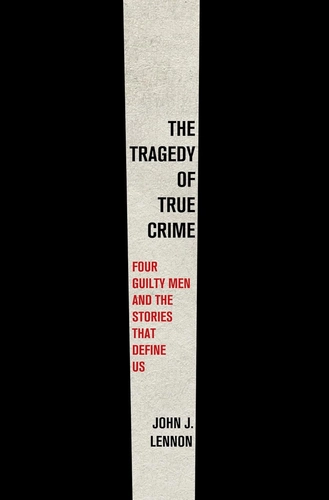
I was scrolling through Netflix the other night. Three hours gone, just like that. Another documentary about a missing woman. Another set of interviews with her grieving family. I sat there, phone in hand, and suddenly felt this strange hollow feeling. What was I doing? Why do we watch this stuff? John J. Lennon’s “The Tragedy of True Crime” landed on my desk a week later, and I swear it was timed by some cosmic joke.
What this book is really asking
Lennon does not write from a comfortable armchair. He writes from somewhere darker. The author spent time in prison himself. He has seen the inside of the system we so casually consume on screen. So when he asks the question, “What are we actually doing when we watch true crime?” it lands differently. It isn’t academic. It is personal. He knows the faces behind the headlines. He has lived with the men we turn into characters in our nightly entertainment.
The book’s central argument is simple and uncomfortable. We tell ourselves we watch true crime to understand justice. To learn. To honor victims. But Lennon suggests something else. Maybe we watch because it makes us feel safe. The monster is out there, not in here. We are the detectives, not the victims. We are the survivors, never the perpetrators.
The protagonist is the reader, and that is the problem
Here is the trick Lennon pulls. The protagonist of this book is not a detective or a killer. It is you. It is me. It is the person who clicks on the next episode without thinking. He takes us through the history of the genre, from pulp magazines to podcast empires. But the real story is about our hunger. He shows us how the industry feeds us. The pacing, the cliffhangers, the dramatic music. All designed to turn tragedy into content.
I will be honest. I felt defensive at first. I thought, “I am not a ghoul. I care about victims.” But Lennon does not accuse. He observes. He points out that the families of victims often feel exploited by the same shows that claim to help them. He shares letters from inmates who see themselves reduced to cartoon villains. It made me uncomfortable. I kept reading.
The core conflict here is between our stated intentions and our actual behavior. We say we want justice. But do we? Or do we want the thrill? The suspense? The feeling of being scared in a safe room? Lennon leaves the question hanging. He does not give you an easy answer.
What the author shows us about light and shadow
Lennon uses an image that stuck with me. He talks about the “subtle light” that true crime consumers miss. The small moments of grace inside prison walls. The boredom. The mundane conversations. The humanity that gets edited out of every documentary. He argues that by focusing only on the crime, we lose sight of the person. Both the victim and the perpetrator become symbols. They stop being human.
This is where the book really shines. Lennon does not ask us to stop watching true crime. That would be naive. He asks us to watch differently. To notice what the camera does not show. To question the narrative. To ask, “Who is telling this story and why?”
He reminds us that every case has layers. The police report is not the whole truth. The Netflix documentary is not the whole truth. The victim’s family and the accused’s family both carry their own versions. We forget this. We want a clean story. Good versus evil. But real life is messy. Lennon forces us to sit in that mess.
The insight that stays with you
I finished the book on a Sunday afternoon. Rain outside. Quiet house. I sat there for a while, not really wanting to start the next show. I realized that Lennon had done something sneaky. He had not told me to stop. He had just made it impossible for me to watch the same way.
He talks about the concept of “witnessing” versus “consuming.” A witness is present. A witness is accountable. A consumer takes and moves on. The difference seems small, but it changes everything. He asks us to become witnesses. To hold the weight of these stories without turning them into entertainment.
The book has its limits. It is short. Some sections feel like they could go deeper. There are moments where I wanted more about the systemic issues, the prison industrial complex, the racism in true crime coverage. Lennon touches on these, but he keeps the focus narrow. On us. On the consumer. That might frustrate some readers.
But maybe that is the point. This is not a book about fixing the system. It is a book about fixing your own eyes. It is for anyone who has ever stayed up late watching a crime documentary and wondered, “Why am I doing this?” It will not make you stop. But it will make you look at yourself in the reflection of the screen. And that, I think, is exactly what Lennon wanted.
True crime does not reveal the monster. It reveals the mirror.
