I sat in a doctor’s office last winter. My daughter had a fever that wouldn’t break. The pediatrician looked at charts, ran tests, shrugged. “Sometimes we just don’t know,” she said. I wanted to scream. How can you not know? That feeling of standing at the edge of a cliff with no map, no flashlight, no handrail—that is exactly what Taylor Harris captures in This Boy We Made.
What happens when your child carries a diagnosis that even the experts cannot fully explain? And what do you do when the questions never stop coming?
The Protagonist Who Refuses to Be a Hero
Taylor Harris is not a warrior mother. She is not a superhero who conquers genetic mysteries with sheer will. She is tired. She is scared. She is a Black woman in America who has learned that the medical system rarely holds space for her fears. When her son T.J. is diagnosed with a rare genetic disorder, the doctors offer no roadmap. They give her a name for the condition, but that name opens more doors to darkness than to light.
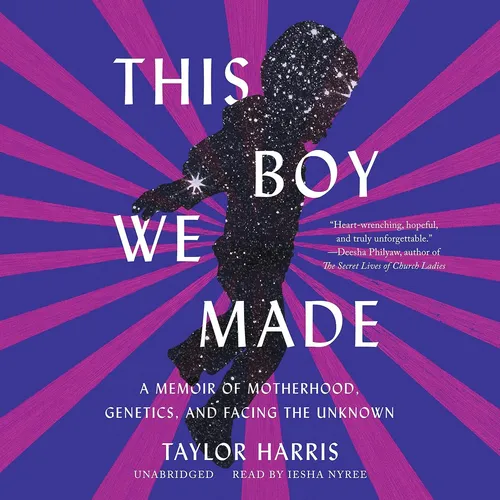
I found myself holding my breath through the early chapters. Harris describes the endless appointments, the blood draws, the sleepless nights spent Googling symptoms no one could confirm. She admits to moments of rage. She confesses to wanting to run away. She resents the platitudes from friends who say “God has a plan.” She does not want a plan. She wants a cure. Or at least a clear sentence about what her son’s life will look like.
The core conflict here is not T.J. versus the disease. It is Harris versus the silence. The medical establishment offers data without meaning. Her family offers love without answers. And she stands between them, holding a child who is both perfectly himself and deeply mysterious. I won’t tell you how the story ends. But I will say this: the ending is not the point. The living through it is the point.
How Light Finds Us in the Darkest Rooms
Harris uses an unexpected image throughout the memoir: the idea of “light leaking.” She writes about how light enters a room not through the center but through the edges, through cracks we never noticed. This is not a triumphant metaphor about hope. It is something more subtle. It is the acknowledgment that we do not find clarity in big moments. We find it in fragments.
The imagery of light appears most powerfully in the chapter where Harris watches T.J. play alone in the backyard. He is stacking rocks. He is talking to himself. She realizes he is not suffering. He is living. The diagnosis has not stolen his joy. It has only stolen her illusion of control. That realization is the tiny crack where the light comes in.
What Harris reveals through this journey is a universal pattern. We all want certainty. We build careers, relationships, and identities around the belief that we can predict outcomes. But life does not cooperate. Illness does not cooperate. Love does not cooperate. The book asks us to consider a terrifying possibility: maybe the goal is not to find answers. Maybe the goal is to become someone who can tolerate not knowing.
What It Means to Stay
I finished this book on a Tuesday morning. My daughter’s fever had broken three days earlier. I had no explanation for why it came or why it left. And I realized, reading Harris’s final pages, that I had been asking the wrong question all along.
The question is not “Why did this happen?” The question is “Who do I become when I cannot know?”
Harris does not offer a neat conclusion. She does not wrap T.J.’s condition in a ribbon of resolution. Instead, she offers a different kind of gift. She shows us what it looks like to hold a child’s hand while walking into fog. She shows us that love is not the opposite of fear. Love is the thing that stays even when fear has no reason to leave.
The book has its limitations. Some readers might want more science, more genetic detail, more concrete information about rare diseases. That is not what this memoir is for. It is for the parents who have sat in waiting rooms, who have heard “inconclusive” and felt their stomachs drop. It is for anyone who has loved someone they cannot fix.
After reading, I felt something I did not expect. I felt permission. Permission to stop searching for the answer that does not exist. Permission to sit in the mess and call it home.
Maybe the bravest thing we can do is not to conquer the unknown, but to love someone through it.
