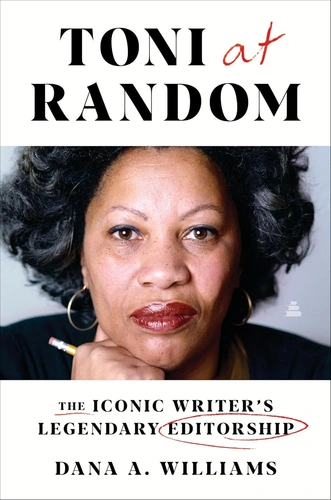
I was at a book launch last year, watching a young novelist sign copies. She thanked her agent, her partner, her parents. She didn’t thank her editor. It struck me then, how invisible that role is. The person who says yes. The person who bets on you before anyone else does. Dana A. Williams’s Toni At Random asks a question that stuck with me: what does it mean to build a legacy not just through your own work, but through the work you make possible for others?
The Editor Who Changed Everything
Most of us know Toni Morrison as the Nobel laureate, the novelist who gave us Beloved and Song of Solomon. But Williams pulls back a curtain I hadn’t noticed. For nearly two decades, Morrison was a senior editor at Random House. She was the first Black woman to hold that position in American publishing. It wasn’t a side gig. It was her main job. She edited Angela Davis, Toni Cade Bambara, Gayl Jones, Muhammad Ali. She fought for books that white editors didn’t understand or didn’t want.
The portrait Williams paints is vivid and human. Morrison was tough. She could be impatient. She demanded excellence because she knew the stakes. When she edited The Black Book, a scrapbook of Black American history, she didn’t just organize images. She insisted on including the painful parts. The lynchings, the humiliations. Her colleagues thought it was too much. She pushed back. The book became a landmark. I felt a strange gratitude reading this. I realized how many books I’ve loved existed because one woman believed they mattered. But here’s the thing. Williams doesn’t hide the cost. Morrison often worked nights on her own novels, exhausted, carrying the weight of two demanding careers. What does it mean to give so much of yourself to others?
The Quiet Labor of Building a Canon
Williams’s central argument is subtle but powerful. Core theme: accomplishments are collective. We love to celebrate the solo genius. The lone artist. But Morrison’s story shows something messier. She didn’t just write great books. She helped create the infrastructure for Black literature to flourish. She edited books that taught us how to read her own work.
There’s a moment in the book that stopped me. Morrison edited The Autobiography of Malcolm X and later said she learned from it how to structure narrative tension. She wasn’t just giving. She was receiving. The light here is subtle. Williams shows how Morrison’s editorial work shaped her own writing. The rhythm, the dialogue, the care for voice. It wasn’t a side project. It was a conversation. I found myself thinking about my own work. Who edited me? Who believed in my early clumsy drafts? I hadn’t thanked them properly. Maybe that’s the point. The people who build the stage rarely get the applause.
Redefining What Legacy Means
I finished Toni At Random feeling unsettled in a good way. We measure success by what we produce. Books published, awards won, names in headlines. Morrison had all that. But this book asks us to look sideways. At the books she edited but didn’t write. The careers she launched. The voices she amplified.
The truth is, I still don’t know how to measure that kind of impact. It’s invisible. It’s in the acknowledgments pages we skim. It’s in the manuscript notes that get thrown away. Williams doesn’t give us a neat answer. She just shows us the work. Maybe that is what legacy really is. Not the monument you build, but the ground you prepare for others to stand on. I closed the book and sent my editor a thank you note. She probably thought I was being weird. But I meant it.
