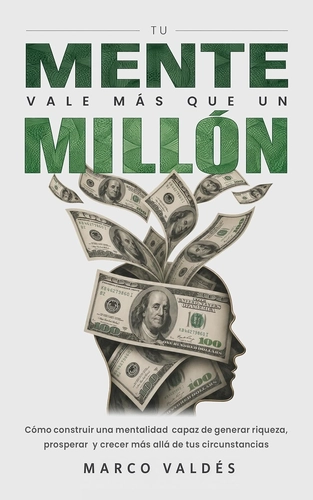
I picked up Marco Valdés’s Tu mente vale más que un millón during a week when my savings account felt like a leaky bucket. Every month, the same ritual. I work hard, I budget, I tell myself next year will be different. And every year, the numbers barely move. I was tired of motivational fluff that evaporates by Tuesday. So I approached this book with skepticism.
The central question Valdés poses is simple and uncomfortable: why do some people advance financially while others stay stuck in the same spot for years, despite equal effort? His answer, repeated with refreshing clarity throughout the book, is that the difference lies not in luck or connections, but in how we think, interpret circumstances, and respond to opportunities. The book argues that wealth generation starts in the mind before it ever touches a bank account.
Valdés builds his case through a protagonist that feels familiar. He describes the person who has started over multiple times, changed countries, changed jobs, adapted and sacrificed, only to watch others move ahead faster. This is not a fictional character. It is the reader. It is me on my worst days. The book’s core conflict is internal: the battle between limiting beliefs and the discipline required to build new mental patterns.
The Fear Disguised as Practicality
What struck me most was a section about fear disguised as practicality. Valdés points out that many of us call our fear “being realistic.” We tell ourselves we are just being prudent when we refuse to pursue a new income stream or negotiate a raise. The book challenges this comfortable self-deception. I caught myself nodding, then feeling annoyed at being seen so clearly. He does not offer a magic formula, which I appreciated. He offers a mirror.
The strongest part of the book, for me, was the emphasis on habits and environment over pure knowledge. Valdés argues that knowing what to do is almost worthless if your daily habits and surroundings pull you back. He uses examples of how the people around us shape our financial decisions, often without our awareness. This resonated deeply. I thought about my own circle, the friends who celebrate frugality as a virtue rather than a stepping stone. The book made me question which of my habits were genuine choices and which were inherited patterns I never examined.
There is a chapter on opportunities that shifted my perspective. Valdés suggests that opportunities are not rare events that randomly appear. They are visible to those whose mindset prepares them to see them. This reframing is powerful. It turns waiting into preparation. It turns passivity into a form of active readiness. I will be honest, this idea felt almost too neat at first. But the more I sat with it, the more I recognized the truth in it. Two people can walk past the same open door. Only one enters.
Where the Book Meets Its Limits
The book is not without its limitations. At times, the advice leans toward the familiar territory of personal development literature. The emphasis on positive thinking, while grounded, occasionally borders on repetition. Some readers might find the tone more motivational than strictly practical. There were moments I wanted more concrete financial mechanics and fewer mindset affirmations. The book also assumes a certain level of privilege—the ability to focus on mindset when basic survival is not the daily emergency.
If you feel stuck in a cycle of working hard without seeing proportional results, this book will meet you where you are. If you’ve started over and feel exhausted by the effort. If you suspect your thinking patterns might be holding you back but don’t know where to begin. If you’re tired of get-rich-quick promises and want a more grounded conversation about financial growth.
If you are looking for specific investment strategies, tax advice, or a step-by-step business plan, this is not the book. If you prefer hard data and case studies over reflective exercises, you might find the approach too soft. And if you are already deeply self-aware about your financial psychology, much of this will feel like review.
The Permission I Didn’t Know I Needed
What I took away was less about money and more about permission. Permission to examine my own patterns without shame. Permission to admit that my circumstances, while real, are not the whole story. The book does not promise to make you rich. It promises something more modest and more achievable. It promises to help you see the ways you might be standing in your own way. That feels like a fair trade.
There is a line in the book that stayed with me. Valdés writes that wealth is not so much about what you have as about what you become capable of seeing. I keep turning that over. It sounds simple, but it is not. It suggests that the real transformation is not in the bank account but in the eyes that read it.
Tu mente vale más que un millón is not a book that will change your life overnight. It is a book that might change how you think about your life. And that, I am learning, is where everything else begins.

