I found Tuesdays with Morrie on a rainy Tuesday afternoon. I was supposed to be cleaning my apartment. Instead, I sat on the floor with my back against the couch and read the whole thing in one sitting. My tea went cold. My phone buzzed with work emails I ignored. By the time I finished, my face was wet and I didn’t care.
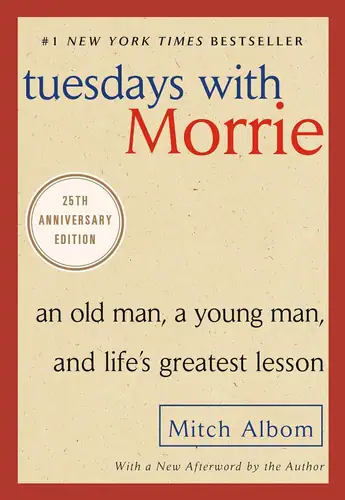
Mitch Albom’s memoir is deceptively simple. A successful sports journalist, Mitch reconnects with his dying college professor, Morrie Schwartz, who is losing his body to ALS. They meet every Tuesday. Morrie talks. Mitch listens. They cover death, fear, aging, money, marriage, love. Fourteen Tuesdays, fourteen lessons. The book is short. The sentences are plain. There’s no literary fireworks here.
And yet.
What struck me most was how Morrie refuses to be a victim of his own dying. He cries when he needs to cry. He lets strangers feed him and wipe his chin. He doesn’t pretend to be brave. But he also doesn’t pretend to be helpless. His body is a prison, but his mind remains free. He chooses gratitude over bitterness, even when his lungs are failing and his hands can no longer hold a book.
The Gift of Presence
The core image of this book is Morrie’s face. Specifically, the way his eyes would soften when someone entered the room. Mitch describes it as a special talent, making each visitor feel uniquely welcome. I thought about my grandmother, who had that same gift. She would light up when I walked into her nursing home room, even on days she couldn’t remember my name. Morrie helped me understand that her smile wasn’t confusion or luck. It was a choice. A discipline of love.
The book’s central argument is this: most of us are dying without knowing it. We chase promotions, mortgages, status. We fill our calendars to avoid facing our own mortality. Morrie says, “Everyone knows they’re going to die, but nobody believes it.” He wants us to believe it. Not to be morbid, but to be alive.
Honestly, I had moments of resistance while reading. The lessons can feel like greeting card wisdom. “Love each other or die.” “Don’t cling to things.” I rolled my eyes a little. But then I remembered that greeting cards sell because they tell truths we keep forgetting. Morrie’s gift is not originality. It’s permission to stop pretending we don’t know what matters.
What the Book Gives and What It Holds Back
The book has a weakness. Mitch’s own story is underdeveloped. We know he is successful and anxious and disconnected from his brother. But he remains a thin character, a vehicle for Morrie’s wisdom. I wanted more of his struggle. I wanted to see him really fight with these ideas, not just nod and cry. The book would have been richer if Mitch had let us see his own ugliness more clearly.
But I think that’s also the point. Mitch is not the teacher. He is us. We are all students in this final classroom.
Tuesdays with Morrie is for anyone who has ever lost someone and wished they had said more. It is for people who feel stuck in a life that looks good on paper but feels hollow underneath. It is for cynics who need permission to be soft. It is not for people who want complex philosophy or literary pyrotechnics. It is not for anyone who is comfortable with their current pace of life and wants to stay that way.
What I took from this book is not a new idea. It is an old idea, polished by Morrie’s dying breath. I learned that the opposite of death is not immortality. It is presence. Being here. Now. With the people who need you. With the life you actually have, not the one you are planning.
This book won’t fix your life. It won’t make you quit your job or move to a monastery. But it might make you pause, just for a moment, and ask yourself a question you have been avoiding: if I died tomorrow, would I be proud of how I lived today? Morrie Schwartz would want you to answer honestly. And then do something about it.
