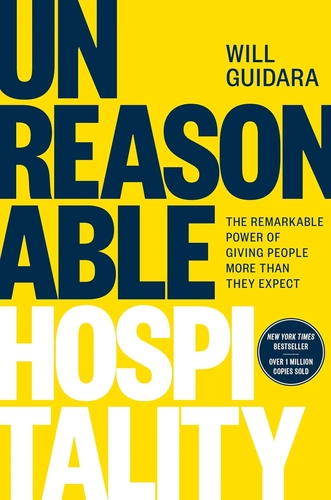
I met this book on a grey Tuesday morning, coffee going cold beside me, the kind of morning where your job feels like a series of boxes to tick. I had picked it up because everyone kept talking about it, and I was suspicious. A book about fine dining, written by a man who ran the best restaurant in the world. What could that possibly have to do with my life?
Three chapters in, I was highlighting like a madwoman. Four chapters in, I was crying into my cold coffee.
The question at the heart of this book is simple and devastating: what if the answer to every business problem is to give more, not less?
The Restaurant That Became a World
Will Guidara was twenty-six when he took over Eleven Madison Park, a two-star brasserie that had never lived up to its beautiful room. The food was good. The service was correct. And nobody cared. He spent eleven years turning it into the best restaurant in the world, and the secret, he insists, was not the food.
It was the hospitality.
The book is full of stories that sound insane and somehow become normal as you read them. A family who had never seen snow gets a private sledding trip in Central Park after dinner. A couple whose vacation got cancelled walks into a private dining room filled with sand, beach chairs, and mai-tais. A table of foodies leaving New York gets a dirty water hot dog from a street cart, wrapped in a fine-dining napkin, as a farewell gift.
I read these and thought, this is ridiculous. And then I thought, why is it ridiculous? Because it’s too generous? Because it costs too much?
The Case for Giving More
The central claim is that we have confused service with hospitality. Service is getting the right plate to the right person at the right table. Hospitality is making a genuine connection with the human being who is sitting at that table. Service is efficient. Hospitality is generous. And Guidara argues, with a conviction that feels earned rather than preachy, that generosity is the better business strategy.
What struck me most was his honesty about the cost. He doesn’t pretend this is easy. He describes the exhaustion of maintaining a culture where everyone, from the busser to the chef, is expected to think like an owner. He admits that he failed, repeatedly, and that the failures were often more instructive than the wins.
There was a moment when I had to put the book down. He describes a period where the restaurant was struggling, and he realized that he had been so focused on the guests that he had forgotten the team. The people who were supposed to deliver the hospitality were running on empty. He had been treating them as instruments, not as people.
I recognized myself in that moment. I think most of us would.
What the Book Gets Right
The book works because it refuses to stay in the restaurant. Guidara is explicit about this: every business is a hospitality business. Every interaction is a chance to make someone feel seen or to make them feel like a transaction.
He talks about the 95/5 rule: spend 95% of your budget on the things that are strictly necessary, and 5% on the things that are “foolish,” the things that create the magic. He talks about the importance of apologizing quickly and sincerely when you mess up. He talks about learning to deliver criticism without emotion and praise with it—one of those simple sentences that takes a lifetime to actually practice.
His father taught him something that stuck: don’t just give advice, explain why. That’s the whole book in miniature. It’s not about the gesture. It’s about the intention behind it.
The writing is direct, almost plain, which I appreciated. No pretension. He’s a guy who loves his work and wants you to love yours. The chapters are short, the stories are vivid, and every principle is grounded in a specific moment. You never feel like you’re reading a management textbook disguised as a memoir.
What the Book Misses
It’s not perfect. There are moments where Guidara’s enthusiasm tips into a kind of corporate pep talk, and I found myself rolling my eyes. The phrase “unreasonable hospitality” gets repeated so often that it starts to lose meaning, like a word you say too many times.
He also glosses over the privilege that makes this possible. It’s easier to fill a private dining room with sand when you’re a Michelin-starred restaurant in Manhattan. The book doesn’t fully address what this looks like for a small business owner who can barely make payroll. He gestures at it, but he doesn’t wrestle with it.
And there’s a certain relentless optimism that can feel exhausting. I wanted him to acknowledge, just once, that some customers are terrible and some employees are not worth keeping. He does, briefly, but it’s not the focus. The focus is always on what you can do, not on what you can’t control.
What I Took Away
Read it if you lead a team, any team. Read it if you’ve ever felt cynical about your work. Read it if you’re in any kind of service role and you’re tired of feeling invisible.
Skip it if you’re looking for a hard-nosed business strategy book. Skip it if you have no patience for earnestness. Skip it if you believe that work is just work and nothing more.
The strongest cage was never iron bars—it was warm, golden affection. Guidara’s point is that we build our own cages when we decide that work is a transaction. He offers a way out, and it’s almost embarrassingly simple: treat people like they matter, and they will surprise you.
This book won’t fix your workplace overnight. It won’t turn you into a generous person if you’re not already inclined that way. But it will make you feel slightly less alone in the moments when you wonder if caring about people at work is naive. And it will make you think about the last time you made someone feel genuinely welcome, and what that cost you, and whether it was worth it.
I finished this book and immediately texted my boss to say thank you for something small he did last week. That’s the effect it has. It makes you want to be the person who gives more.
People will forget what you said and what you served, but they will remember how you made them feel. That’s the whole thing, isn’t it?

