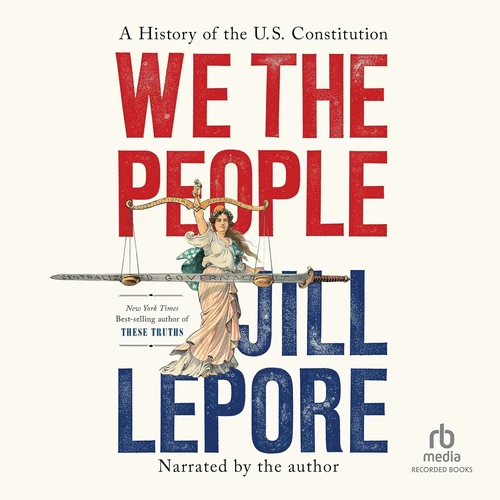
A few months ago, I sat through a neighborhood association meeting that nearly broke me. A seventy-year-old rule said no front-yard fences. A young couple with a toddler wanted a small gate for safety. The rule won. It always wins. I walked home thinking about how often we let old regulations strangle new needs. That feeling came back hard when I opened Jill Lepore’s “We the People: A History of the U.S. Constitution.”
This is a 700-page book about a piece of parchment. But Lepore, a Harvard historian, makes it feel like a thriller. She asks a simple question that haunts every page: Who should have the power to interpret the Constitution — the people who wrote it 250 years ago, or the people living under it today?
The Character of a Living Document
Lepore does not write about abstract clauses. She writes about people fighting over them. There is Frederick Douglass, a former slave, standing before an audience in 1852 and declaring that the Constitution was a “glorious liberty document.” He had to argue this against a Supreme Court that had just ruled in Dred Scott that Black people were not citizens. There is Susan B. Anthony, arrested for voting in 1872, insisting the Fourteenth Amendment already gave women the right. The courts said no.
The book is stuffed with these moments. Lepore shows how every generation has grabbed the Constitution and tried to pull it toward their own vision of justice. Some pulled for slavery. Some pulled for freedom. The Constitution itself did not change much. The people interpreting it changed.
I will be honest. I expected a dry march through amendments and court cases. Instead, I got a portrait of a nation constantly wrestling with itself. The suspense is real. You know the broad outcomes, but Lepore makes you feel the uncertainty of each moment. Will the Court side with the slaveholder or the abolitionist? Will the amendment pass or fail? She never gives away the ending before she sets up the stakes.
The Craft of Constitutional Storytelling
Lepore’s core theme is what she calls “the dead hand problem.” Should we be governed by the views of men who died two centuries ago, who owned slaves and denied women the vote? Or does each generation have the right to reinterpret the founding text in light of new moral understandings?
Her key imagery is the Constitution as a “living body” versus a “dead letter.” She traces this metaphor through American history. Early nationalists called it a “machine that would go of itself.” Later critics called it a “chain on the living.” Lepore shows how these metaphors shaped real legal battles. When Chief Justice Roger Taney wrote the Dred Scott decision in 1857, he argued that the original framers never intended Black people to be citizens. He used the dead hand to strangle freedom. When Justice Thurgood Marshall argued for school desegregation in 1954, he said the framers’ original intent was irrelevant. What mattered was the Constitution’s capacity to grow.
Lepore’s craft is subtle. She does not lecture. She piles up stories until the reader sees the pattern. Every chapter feels like a small drama. A crisis. A debate. A decision. She moves fast, covering 250 years in 700 pages. The pace forces you to see how quickly things change and how stubbornly they stay the same.
What This Book Means for Us
Here is why this book matters. We live in an age of originalism. The Supreme Court’s majority now argues that the Constitution must be interpreted as the framers understood it. That means a woman’s right to an abortion, once protected, is now gone. That means affirmative action, once allowed, is now banned. The dead hand is squeezing hard.
Lepore does not hide her own views. She is a liberal historian. But the book is not a polemic. She treats originalist arguments seriously, showing how they emerged in the 1980s as a conservative response to liberal activism. She also shows how they have changed over time. Originalism today is not what it was forty years ago.
The book has weaknesses. It is dense. Some chapters feel rushed. I wanted more on the Reconstruction amendments and less on the early republic. But these are small complaints. The book delivers what it promises: a sweeping, human history of how Americans have argued about their founding document.
Who should read it? Anyone who has ever felt trapped by an old rule. Anyone who has wondered why a document from the 18th century still governs our lives. Anyone who wants to understand the deep roots of today’s political battles.
What will you get? A clearer sense of why the Constitution is both our greatest inheritance and our most frustrating constraint. You will also get a powerful argument that the document’s meaning was never fixed. It was always fought over. That fight is what democracy looks like.
So here is the question Lepore leaves us with: If the Constitution belongs to the living, what will we do with it?
