I remember a summer a few years back. The sky turned orange for three days straight. Not a dramatic orange, more like a sickly amber that made everything look old and tired. People wore masks outside, not because of a virus, but because the air tasted like a campfire that wouldn’t end. I didn’t think much of it then. I figured it was a fluke, a weird weather event. Then I picked up Jordan Thomas’s “When It All Burns: Fighting Fire in a Transformed World,” and I realized that summer wasn’t a fluke. It was a preview. The question I kept asking myself while reading was simple and unsettling: What do we do when the ground beneath our feet is always smoldering?
A Firefighter on the Edge of Everything
Thomas isn’t a politician or a scientist sitting in a lab. He’s a firefighter, a person who has walked into burning forests with a hose and a prayer. The book opens with his boots on the ground, in a California canyon where the flames move faster than any human can run. I found myself holding my breath in the first chapter. He describes a moment where the fire turns on him, the wind shifting, the heat so intense that his helmet visor begins to warp. It wasn’t heroic. It was terrifying and clumsy. He admits he almost ran the wrong way. That honesty hooked me. He is not a superhero. He is a man who has seen the fire change its mind.
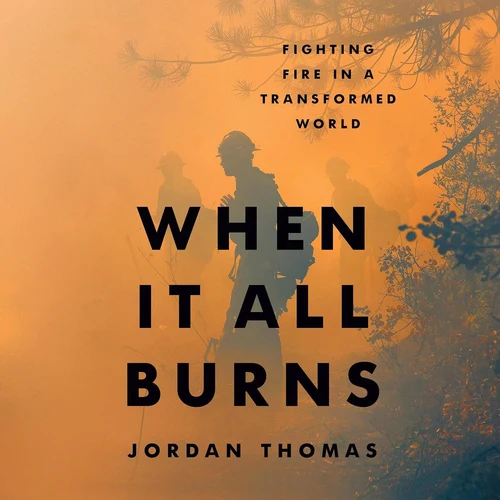
The core of the book is about his transformation. He started his career believing that fire was an enemy to be defeated. You drop water, you dig lines, you win. But over the years, he watched the old rules break. A fire that should have stopped at a river crossed it. A fire that should have died at night grew stronger. He began to realize, slowly, that the problem wasn’t the fire itself. It was the landscape. We built houses in places that were always meant to burn. We suppressed small fires for a century, and now the forests are filled with dry fuel, like a powder keg waiting for a match. What does a firefighter do when his entire playbook is obsolete?
The Real Fire Is in Our Heads
I think the most powerful part of the book isn’t about flames at all. It’s about how we see the world. Thomas introduces a concept that stuck with me: “the fire of separation.” He argues that the wildfire crisis is not just a climate issue, but a spiritual one. We separated ourselves from the land. We thought we could control nature, fence it in, make it safe. But nature doesn’t work that way. It moves. It breathes. And sometimes, it burns.
The imagery he uses is stark. He writes about “zombie fires,” blazes that smolder underground all winter, then resurface in spring. These fires don’t die. They wait. I kept thinking about that metaphor for our own anxieties. The things we bury, the worries we ignore, they don’t disappear. They smolder. Thomas also talks about the “fire line,” the edge where the fire stops. But in a transformed world, he says, the fire line is not a physical place. It’s a boundary in our minds. It’s the line between believing we can control everything and accepting that we can only adapt. Honestly, I found that idea both frightening and freeing. We are not in charge. We are participants.
Of course, the book has its flaws. Thomas gets a bit repetitive in the middle, circling back to the same stories of burned houses and brave crews. I wanted more about the policy failures, the insurance crises, the politics of it all. He touches on them, but he doesn’t dig deep enough. Still, that might be the point. He is a firefighter, not a policy wonk. His strength is in the visceral, the immediate, the smell of smoke in your clothes.
The Only Way Out Is Through
So what do we get from this book? I think it offers a kind of permission. Permission to stop pretending that we can solve everything with a better technology or a smarter plan. Thomas suggests that living with fire means learning to live with uncertainty. It means building communities that are resilient, not just wealthy. It means letting some fires burn, because total suppression only makes the next one worse. It means acknowledging that some places we love will be lost, and we have to decide what is worth saving and what we must let go.
I finished the book on a cool autumn evening, the air clean and clear. But I couldn’t shake the feeling that the smoke was still there, somewhere, just over the horizon. I recommend this book to anyone who has ever felt that something fundamental is shifting, but couldn’t find the words for it. It is not a handbook for survival. It is a mirror. It asks you to look at your own life, your own house, your own assumptions about safety. Maybe that is the only real preparation. Not building a bunker. But learning to see the fire for what it is: a part of the world we forgot we belonged to.
