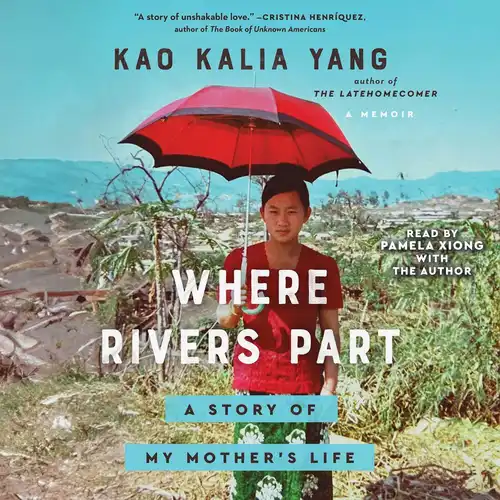
I got a call from my mother last week. She asked if I had eaten. We talked for seven minutes. She never told me about the time she walked twelve miles through a monsoon to save her brother’s life. I never asked. That is the silence Kao Kalia Yang writes against in Where Rivers Part: A Memoir of a Mother‘s Survival. Yang’s mother, Chue, spent decades as a refugee, a wife, a mother of seven. But who was she before all that? What did she dream of? What did she lose that cannot be named? This book asks a painful question: Can a daughter truly know her mother, or is she always meeting a stranger wearing a familiar face?
The Woman Who Survived, and the Woman Who Watched Her
Chue Yang was born in Laos. She grew up in a village where the river was her playground and the jungle her pantry. Then the war came. The Hmong people were caught between American bombs and Pathet Lao soldiers. Chue survived a refugee camp in Thailand. She survived a marriage arranged by family. She survived multiple miscarriages, each one a quiet grief she carried alone.
But here is what Yang does that makes this memoir ache. She does not just tell us about suffering. She shows us Chue laughing at a wedding. She shows us Chue as a teenager, sneaking glances at a boy across the rice fields. She shows us a girl who loved to sing. The cruelty of war is not the bombs. The cruelty is that it erased that girl. Yang writes with a poet’s precision. One sentence about a mango tree. The next about a dead child. The shift is so fast you feel dizzy. That is what trauma does. It does not give you time to breathe. I found myself holding my breath through whole chapters. The ending? I will not tell you, but I will say this: it is not the ending you expect.
The River That Carries Everything
Yang uses two rivers as her core image. The Mekong in Laos. The Mississippi in Minnesota. On the surface, they are just geographic markers. But Yang is smarter than that. The Mekong is a river of memory. It holds the bodies of the dead, the sound of women washing clothes, the taste of river fish. The Mississippi is a river of forgetting. It carries her mother away from war but also away from her own language, her own stories.
The core theme here is what gets lost in survival. We think survival means living. But Yang shows us that survival often means burying parts of yourself so deep that you cannot find them later. Chue does not talk about the war. She does not talk about the babies she lost. She talks about the garden. She talks about cooking. She becomes a woman of actions, not words. And her daughter, Kao Kalia, becomes the one who must dig for the words. There is a moment in the book where Chue finally speaks. It is not dramatic. It is just a sentence about a tree. But Yang catches it. She knows that for a silent woman, one sentence is a flood.
What We Owe the Women Who Carried Us
This book belongs to a specific generation. The Hmong refugee generation. But it speaks to something bigger. Every immigrant family has a silent mother. Every family has a woman who does not tell her story because she is too tired, because no one asked, because the language of survival is not the language of storytelling. Yang does something rare. She does not make her mother a saint. She does not romanticize the suffering. Chue is difficult. She is stubborn. She sometimes seems cold. Yang admits this with love, not blame.
What can you get from this book? A new way of seeing your own mother. A recognition that the woman who nags you about eating vegetables was once a girl who climbed trees. A permission to ask the hard questions while there is still time. The weakness of the book? Sometimes Yang’s lyricism overwhelms the narrative. The sentences are so beautiful they can distract from the pain. But maybe that is the point. Beauty is how we survive. I recommend Where Rivers Part to anyone who has ever felt that they do not truly know the woman who raised them. Read it. Then call your mother. Ask her about the tree.
