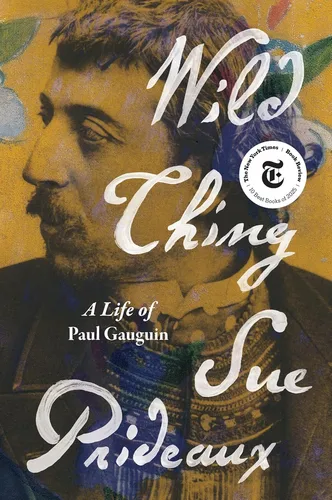
I was at a dinner party recently, and someone brought up Gauguin. The table split instantly. Half called him a colonial predator who abandoned his family to paint brown women. The other half defended his art as revolutionary. I sat there, fork suspended midair, unable to pick a side. That night, I picked up Sue Prideaux’s “Wild Thing: A Life of Paul Gauguin.” I needed to know: can a monster also be a genius, or is that just a story we tell ourselves to feel better about beautiful things?
The man who ran from everything
Gauguin was a stockbroker with a wife and five children when he decided to paint full time. He left them. Not gently, either. He drifted to Brittany, then Panama, then Martinique, finally settling in Tahiti and the Marquesas. Prideaux doesn’t flinch from his cruelty. She shows us a man who wrote cold letters home, who took teenage wives in the islands, who infected them with syphilis. I winced reading some passages.
But here is where the biography gets interesting. Prideaux also shows us his pain. Gauguin was poor, sick, and rejected by the French art establishment. He genuinely believed European civilization was rotting people’s souls. His search for something “primitive” was naive and sometimes harmful, but it was not entirely insincere. The book makes you sit with that discomfort. You keep waiting for a clear verdict, a moment where Prideaux says “he was good” or “he was bad.” She never does. The question just hangs there.
The craft of holding two truths
Prideaux’s key trick is subtle light. She never over-illuminates Gauguin’s darkness, nor does she cast him in heroic shadow. She just shows you the man’s full spectrum and lets you squirm.
The key imagery here is Gauguin’s own paintings. You see them reproduced in the book, those bold colors and flattened forms. And you realize: they are beautiful. They really are. But they also depict young Tahitian girls, posed for a European male gaze. Prideaux doesn’t need to lecture you about this. She just places the images alongside the letters and the court records. The contradiction becomes yours to resolve.
I found myself arguing with the book as I read. “But he was a great artist,” I’d think. Then: “But he was a bad person.” Then: “Can’t both be true?” That is exactly what Prideaux wants. She is not writing a prosecution or a defense. She is writing a meditation on how we judge people who produce work we love.
The question we cannot escape
Here is what I finally realized, weeks after finishing the book. The Gauguin problem is not really about Gauguin. It is about us. We live in a culture that wants clean moral categories. Good people make good art. Bad people make bad art. But Gauguin refuses that neatness, and Prideaux refuses to impose it.
Maybe that is the real value of this biography. It trains you to hold complexity without collapsing into relativism. You can say: his art matters, and his actions hurt people. You can love the paintings and hate the painter. You do not have to resolve the tension. You just have to live with it.
I closed the book still uncertain about Gauguin. But I was more certain about something else: the people who insist on easy answers are usually the ones who have not read deeply enough. “Wild Thing” is a gift for anyone willing to sit in the messy middle.
