You’ve heard the advice. “Just breathe.” “Count to ten.” “It’s all in your head.” None of that helps when your heart is slamming against your ribs at 2 a.m. and you’re certain this is the end.
I’ve been there. So have a former Marine, a retired nurse, and a graphic designer who couldn’t stop spinning. Here’s what actually worked for us.
1. Find your boring photo.
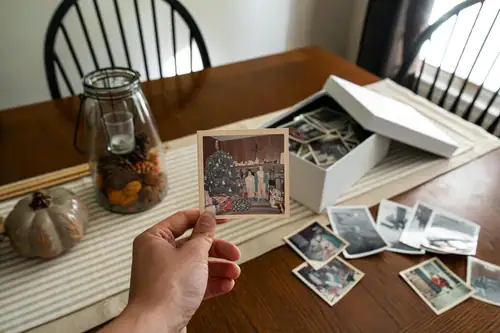
I keep a stupid photo on my phone. It’s my kitchen counter: a dried milk stain next to half a banana with a black spot. Every time an attack starts, I flip to that photo and stare at it for ten seconds. Why? Because my brain is screaming “disaster!” but the photo tells the truth: ten minutes ago, the biggest emergency in my life was a milk spill. No one is dying. Nothing is on fire.
A nurse I know tapes a sticky note to her locker that says “hand sanitizer.” When she feels panic coming, she smells her sleeve. Same idea. It yanks you back to now.
Here’s the move. Before the next attack, scroll through your phone and pick one boring, ugly, real photo. Not a vacation shot. Not a selfie. Something ordinary, even messy. When you feel that first jolt, pull up that photo and look at it for ten seconds. Then ask yourself one question: is that thing still there? Is anyone bleeding? No. You just pulled the plug on the future.

2. Hand on chest. No breathing.
Marcus taught me this. He’s a former Marine, twin dad, and runs heavy machinery. His panic attacks used to hit every morning like an alarm clock. He tried everything: running, meditation, box breathing. Nothing worked.
Then a family doctor asked him a weird question: “Next time that current hits, put your palm on your chest and tell me, is that skin cooler or warmer than the back of your hand?”
Marcus thought it was ridiculous. But he tried it. That night the jolt came. He put his hand on his chest. Cool. Just like that, the alarm in his head stuttered, not gone, but interrupted. Because his brain suddenly had a boring, factual job instead of writing disaster movies.
Try this instead. Feel that electric zap? Don’t breathe. Don’t count. Put your hand on the center of your chest. Ask yourself one stupid question: cooler or warmer? That’s it. No fixing. No positive affirmations. The answer doesn’t matter. You just hijacked your brain from “screenwriter” to “thermometer.”
3. Name three facts. This one saved me in a grocery store.
I used to think this method was too simple to work. Then last winter, I was standing in the cereal aisle of a Safeway, and my chest went tight. Not the usual “I’m a little stressed” tight. The real one, the kind where your field of vision narrows, your palms get slick, and every sound turns into a threat.
The woman next to me was calmly comparing oat milk brands. A kid was whining for Lucky Charms. Normal people doing normal things. And I was convinced I was about to pass out, or vomit, or both.
I couldn’t leave because my cart was blocking the aisle. I couldn’t stay because my body was screaming “run.” So I did something stupid. I remembered a line from a podcast I’d heard months earlier: name three things you can see. Three things you can touch. Three things that are real right now.
I whispered it under my breath. “Floor tiles. Gray. Lots of them. Shopping cart handle, cold, metal, my left hand is squeezing it. The red box of Annie’s mac and cheese right in front of my face.”
I didn’t do nine things. I did three. That was it. The tunnel vision didn’t vanish, but it stopped expanding. The suffocating feeling loosened its grip just enough for me to take a half step forward. I grabbed the mac and cheese, pushed my cart to checkout, and made it home without collapsing.
Your turn. Three steps.
The moment you start spiraling, don’t argue with the fear. Just look around.
Find three physical facts, not feelings, not predictions. Examples: “The floor is gray tile. The cart handle is cold. There’s a red box in front of me.”
Say them out loud or in your head. Count them on your fingers if you need to.
You’re not trying to feel better. You’re just proving to your brain that you’re still in a real place, with real objects, and nothing has exploded yet. That tiny gap, between the panic and the facts, is where your breathing comes back.

4. Two minutes with your hands.
Not exercise. You can’t run when you’re shaking. I’m talking about something boring, repetitive, and physical.
A graphic designer in Portland spent five years fighting with meditation. Then he found a hand crank pencil sharpener. “One crank, check the point. Another crank, check the point,” he said. “That’s all my brain can handle. No room for disaster stories.”
Another person I know hand washes one sock. Scrub, rinse, wring, hang. Your hands are in the water. Your eyes are on the fabric. Your brain has no extra bandwidth for fear.
Do this now (or when the attack starts):
Find the most boring thing in your house, like a dull pencil, a pile of paper clips, or a dusty shelf.
Do something with your hands for two minutes. Sort the paper clips by color. Wipe the shelf with a rag. Sharpen that pencil with a hand crank.
Set a timer. When it goes off, stop. No extra credit.
You just gave your nervous system a rest stop.
5. Say five words out loud.
This is the hardest one. It’s also the one that works fastest.
The last time I had an attack, I was alone in my kitchen. My daughter was watching TV in the other room. I dropped to the floor and grabbed the cabinet handle. I couldn’t breathe. Then I said five words out loud: “It’s happening again. Okay.”
That was it. No “please stop.” No “why me.” Just “okay.” And somehow, saying “okay” took the fight out of it. Because I stopped pretending it wasn’t there. I just admitted it.
The only rule. Use five words or less. Say them out loud, even if you’re alone. Examples: “Here it is.” “I’m scared.” “Okay, this sucks.” Don’t argue. Don’t negotiate. Just acknowledge. Anxiety hates being seen. The second you name it, it loses about half its power.
One last thing. Pick the one that sounds stupidest to you. The one that makes you think “that can’t possibly work.” Try that one first. Anxiety’s biggest enemy isn’t calm; it’s one small, weird, specific action.
And here’s a quiet truth someone passed to me: if that same dread keeps climbing into bed with you every morning, the one that makes you wake up tired and already defeated, there’s another set of tools that doesn’t look anything like these. No hand on chest. No counting facts. Just a 90 second timer and a question that dismantles thoughts from the inside. A friend who’d been stuck in that loop for years told me about it. I wrote those stories down separately, because they don’t belong in an “in the moment” list. If you’re curious, they’re called How to Break the Cycle of Anxiety and Depression: The Loop Doesn’t Own You. No pressure. Just a bookmark for later.
